 Connext
 combined token bridging with crosschain contract calls
Connext was an interoperability protocol that moved tokens and carried instructions between contracts on different blockchains and rollups. Its
xcall
interface supported funds, messages or both. Fast delivery depended on destination liquidity and whether the receiving function required authenticated origin information. The project later rebranded as Everclear and shifted toward liquidity clearing. The legacy architecture joined liquidity provision with message verification, while receiving applications handled their own execution logic and permissions.
Sections in this article
Connext’s fast path could deliver funds before reconciliation, while calls that checked the originating sender required authenticated messaging.
The shift toward liquidity clearing
Connext announced its rebrand to Everclear on June 3, 2024. The announcement introduced a clearing-layer direction centered on liquidity rebalancing. It addressed capital that solvers accumulated on different chains while fulfilling users’ desired outcomes, known as intents.
The clearing design coordinated opposing capital flows through netting and settlement. The historical
xcall
interface centered on token delivery and destination contract instructions. A bridge call and a rebalancing intent therefore described different operations, even though both involved moving value between chains.
The connection between xcall and xReceive
The
xcall
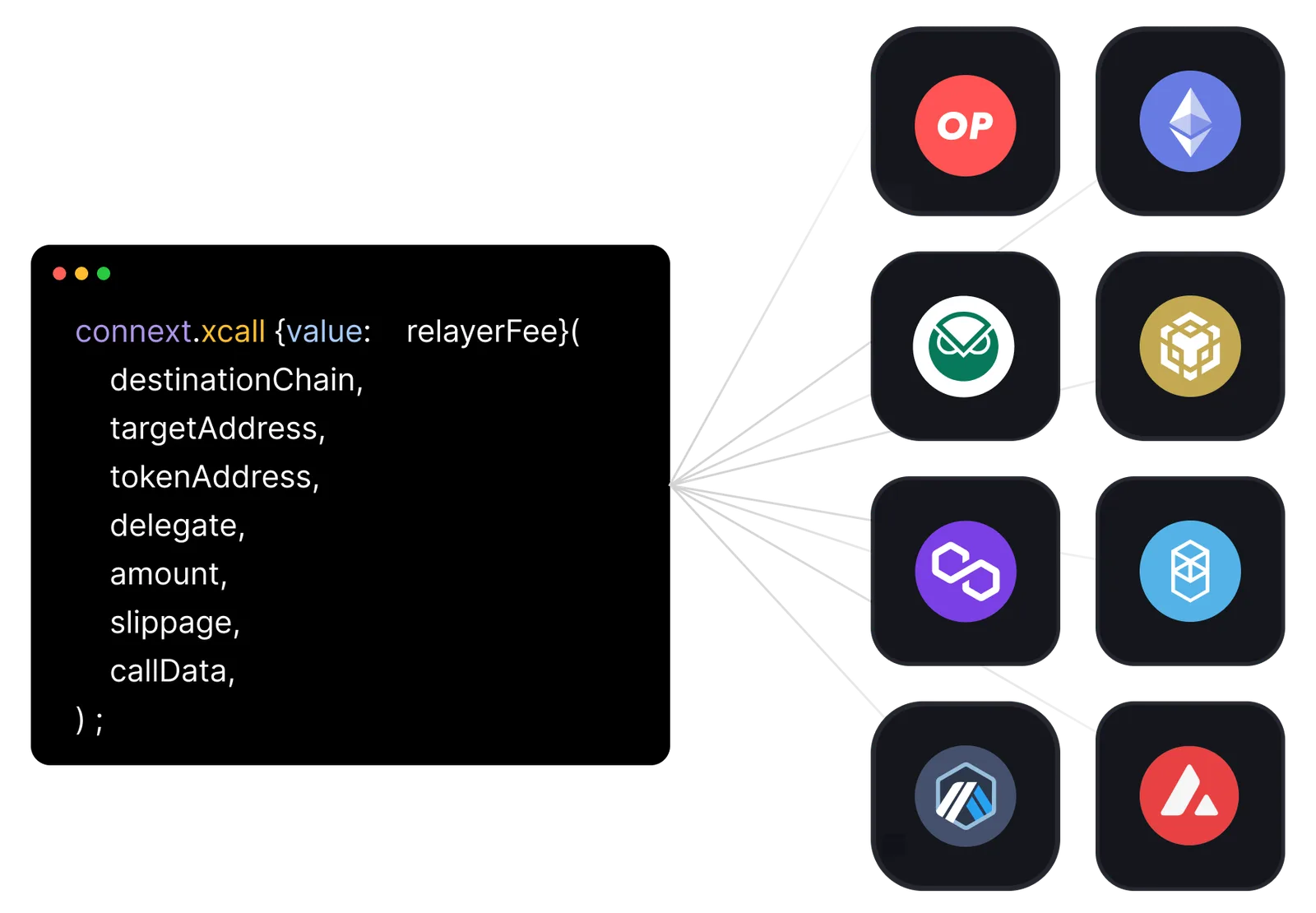
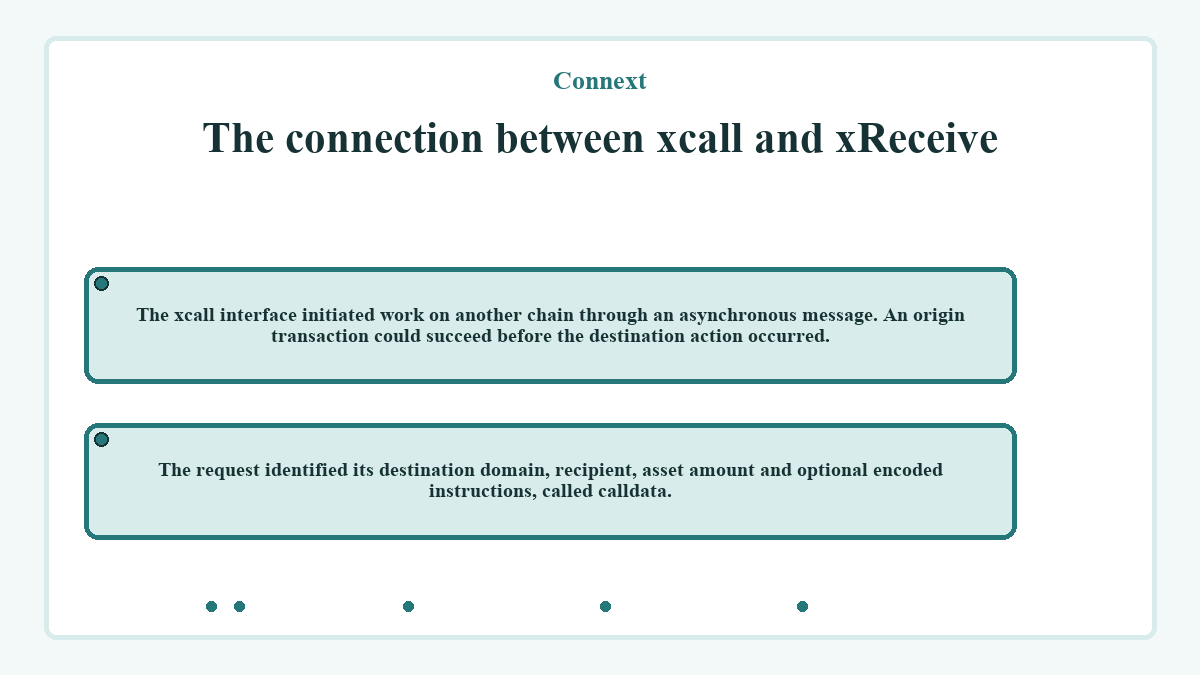
interface initiated work on another chain through an asynchronous message. An origin transaction could succeed before the destination action occurred. The request identified its destination domain, recipient, asset amount and optional encoded instructions, called calldata.
Token delivery and receiving logic
Token-only transfers used empty calldata and could name a wallet as their destination. Contract interactions supplied a payload to a receiving contract through
xReceive
. That receiver decoded the payload and invoked its application logic. The interface connected delivery with execution; the receiver determined what the delivered message actually did.
Messages without a token transfer
Data-only calls used a zero token amount while still identifying a registered asset. This branch carried instructions without funds; authentication requirements depended on the receiving function.
Why did some transfers need the slow path?
A transfer needed the slow path when destination router liquidity was insufficient or the receiving contract required verified origin information.
Available destination liquidity
Token-only transfers and calls to functions that accepted any caller could qualify for fast delivery. Routers needed enough liquidity in the relevant destination asset. Without that liquidity, the transfer waited for the underlying messaging process, even when its receiving function required no origin authentication.
Authenticated origin information
A receiver that restricted its originating caller needed authenticated messaging. Its checks covered the expected origin domain, the expected origin sender and the destination protocol contract that called it. Checking an address without its domain would omit part of that permission boundary. Authentication therefore changed the delivery path as well as the receiver’s access controls.
Routers, the sequencer and relayers
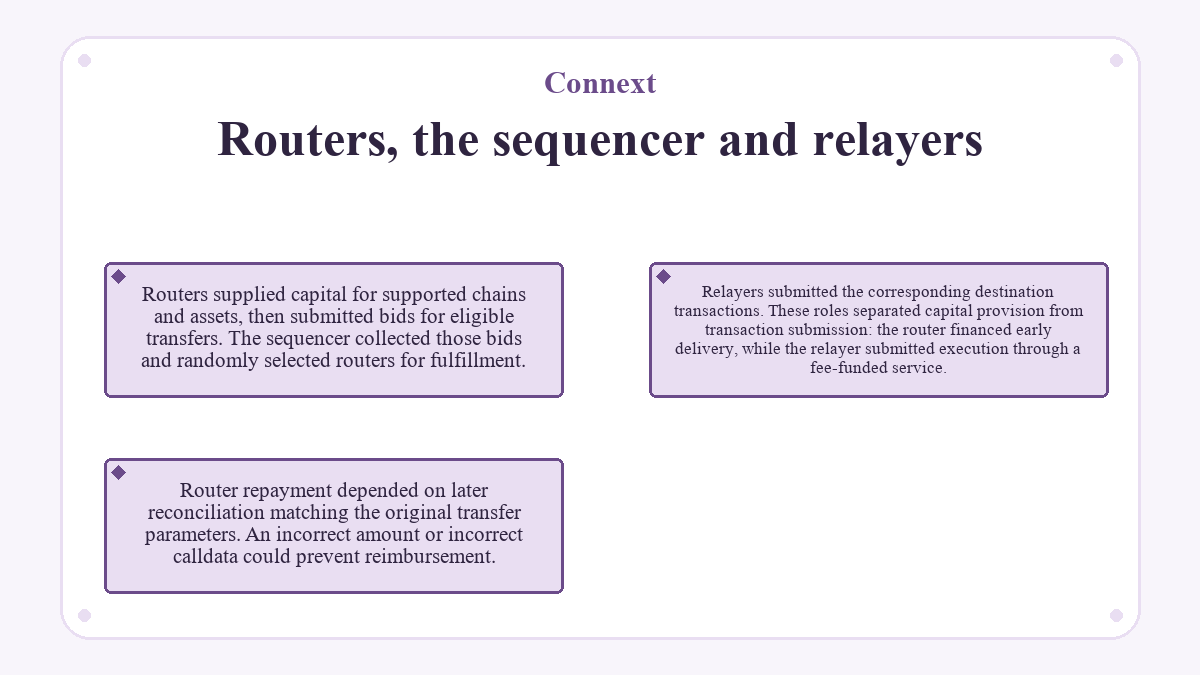
Routers supplied capital for supported chains and assets, then submitted bids for eligible transfers. The sequencer collected those bids and randomly selected routers for fulfillment. Relayers submitted the corresponding destination transactions. These roles separated capital provision from transaction submission: the router financed early delivery, while the relayer submitted execution through a fee-funded service. Router repayment depended on later reconciliation matching the original transfer parameters. An incorrect amount or incorrect calldata could prevent reimbursement.
Why could a deposit arrive before a governance instruction?
A public deposit could qualify for fast delivery, while a governance instruction that restricted its originating caller required authenticated messaging. In this hypothetical comparison, assume supported deployments, an enrolled token and sufficient destination liquidity. One receiver accepted public vault deposits; another restricted governance changes to a designated contract on a designated origin chain.
The deposit could combine token delivery with a public contract call before reconciliation. Its receiving contract could fund the vault position without waiting for verified origin-sender information. The governance receiver needed the slow path because its permission check relied on that information. Available liquidity answered the funding question, while authentication answered who could authorize the change.
If destination liquidity became insufficient, the deposit would also need the slow path. Extra liquidity would not remove the governance receiver’s authentication requirement.
Ethereum roots and canonical bridge verification
The hub-and-spoke messaging system aggregated spoke-domain message roots on Ethereum L1 and connected domains through their canonical messaging bridges. A Merkle root committed to a batch of messages, allowing bridge connectors to carry that commitment between domains. The design used optimistic root aggregation and specified canonical-bridge fallback if fraud occurred. Watchers monitored the network and could halt message passing when they detected fraud or a hack. These protections relied on the relevant bridge infrastructure and protocol contracts. Receiver bugs remained a separate application risk, even when the messaging layer delivered the intended payload.
Token representations and xERC20 control
The legacy contract distinguished the adopted asset from its local bridge representation. A configured swap connected different representations when necessary. Inputs that already matched the local asset needed no conversion. Origin-side logic held canonical local assets in custody and burned representations of assets native elsewhere.
The xERC20 model addressed issuer control over crosschain token supply. Issuers controlled their token deployments and authorized bridges with individual minting and burning limits. This open standard, associated with ERC-7281, differed from relying on a bridge-controlled token wrapper. It supported transfers without swap slippage while preserving issuer control over approved bridges. Any additional swap inside a receiving application had its own price and slippage conditions.
Router fees, relayer fees and swap slippage
The legacy xcall model charged 0.05% of the transferred asset for router-provided fast liquidity. Slow-path transfers did not incur that router fee. The percentage described one liquidity service; it did not represent the complete cost of a crosschain interaction. Origin transaction gas and destination execution introduced separate cost inputs.
Relayer fees funded destination submission and varied with the chain and service provider. The interface supported payment in the origin chain’s native asset or the transferred asset through different overloads. An estimate could become insufficient when gas conditions changed. Transfers that involved token swaps also depended on their configured slippage tolerance, a separate constraint from the payment that compensated relayers.
Bridge settlement and destination execution
The transfer lifecycle distinguished origin submission, destination execution and reconciliation. The
XCalled
state identified initiation on the origin chain. It did not establish delivery to the destination receiver, execution of its instructions or completion of bridge settlement.
A fast-path transfer could reach
Executed
before reconciliation. The router had supplied destination funds, while the underlying message still needed to catch up. This ordering separated early delivery from the later settlement that supported router reimbursement.
A slow-path transfer followed the opposite ordering: reconciliation preceded execution. This ordering allowed origin information to become authenticated before the receiving contract relied on it. The destination action still formed part of the lifecycle after message verification.
The tracking model called the completed orderings
CompletedFast
and
CompletedSlow
. These labels distinguished execution followed by reconciliation from reconciliation followed by execution.
The external-call event carried a success flag and return data for the receiver invocation. Asset delivery and successful application execution remained different outcomes when receiving logic reverted.
Applications beyond wallet transfers
Crosschain applications could attach useful work to token delivery or send instructions without funds. Each design needed receiver logic that matched its intended action and permission requirements.
Governance and financial applications
Potential uses included executing decisions from a decentralized autonomous organization (DAO) on other chains. Other concepts combined decentralized exchange liquidity, funded vault deposits or managed vault strategies. Lending on one chain and borrowing on another also fit the model. Their shared messaging interface did not make their contract permissions or financial conditions identical.
NFTs, price data and storage
The proposed applications also included bridging non-fungible tokens (NFTs) and operating marketplaces across multiple chains. Other designs aimed to carry Uniswap v3 time-weighted average prices between chains or trigger Arweave and Filecoin storage from Ethereum contracts. These were application concepts, with deployment and receiving behavior specific to each implementation.
Receiver failures and recovery boundaries
Failure handling depended on where an interaction stopped. A swap failure on the origin chain reverted the initiating call. A destination swap could face excessive slippage after the origin action had already succeeded, creating a different recovery problem.
Destination-side options included waiting for conditions to improve or increasing the permitted slippage. Neither option guaranteed a particular execution time or received amount. Increasing tolerance widened the price movement that the transfer would accept; it did not improve the underlying exchange rate.
A reverting receiver call could leave delivered funds on the receiving contract. Developers therefore needed error handling and a way for the rightful owner to recover those funds. Developers then had to choose who could recover stranded funds; authenticating the origin sender required the slow path.
Connext FAQs
-
Is a Connext domain ID the same as a chain ID?
- A Connext domain ID was distinct from a chain ID. The xcall destination parameter expected the protocol’s domain identifier. Substituting a wallet network’s chain ID without the correct mapping could supply an incorrect destination parameter.
-
Who could increase an underfunded relayer fee?
- Anyone could increase a transfer’s relayer fee through bumpTransfer on the origin domain. The function supported payment in the native asset or a specified transacting asset through different overloads. This operation added compensation for relayers; it did not change the receiving contract’s instructions or guarantee immediate execution.
-
Which account could change a transfer’s slippage tolerance?
- The delegate designated in the original xcall could update destination slippage through forceUpdateSlippage. This call belonged on the destination chain and required the original transfer parameters. That authority differed from increasing a relayer fee, which the protocol allowed anyone to fund on the origin chain.
-
Could several routers fund the same transfer?
- The legacy architecture allowed multiple routers to fulfill a single transfer. The sequencer could select contributions from more than one router, allowing their available liquidity to support the same transfer. This did not remove the requirement for enough destination liquidity or the authentication rules of the receiving contract.
-
What did xcallIntoLocal change about the received asset?
- The xcallIntoLocal helper forced receipt of the protocol’s local asset on the destination chain. The legacy interface supported this option for obtaining nextAssets for destination stableswap liquidity. When the local asset differed from the chain’s adopted asset, the choice changed which representation the recipient received.
-
How did a transferId differ from a transaction hash?
- A transferId identified the crosschain transfer, while a transaction hash identified a particular onchain transaction. The tracking interface associated origin and destination records with the transferId. It also exposed transaction hashes for the chain-specific actions, allowing their records to refer to the same broader interaction.